


論文『πアーマー:芳香族化合物の形状相補的カプセル化』がJACSに掲載されました
π-Armor: Shape-Complementary Encapsulation of Aromatics
Haruka Kano, Takashi Harimoto,* Yasutomo Segawa*
J. Am. Chem. Soc. 2026, DOI: 10.1021/jacs.6c17351
ChemRxiv DOI: 10.26434/chemrxiv.15007230/v1
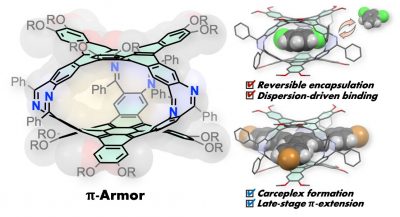
Host–guest binding can be classified into two well-separated modes: reversible binding under thermodynamic control and permanent encapsulation via kinetic trapping during host formation. However, combining both modes within a single π-conjugated host on the basis of host–guest shape complementarity has remained a challenge. Herein, we present the design and synthesis of a neutral D3-symmetric π-conjugated cage in which two curved hexa-cata-hexabenzocoronene panels are bridged by dibenzodiazocine units to form three orifices and a biconvex nanocavity. The cage reversibly encapsulates aromatic guests, with binding affinities governed by dispersion arising from shape complementarity. In contrast, bulky guests that are too large to pass through the orifices are incorporated during cage formation and permanently entrapped, affording thermally robust carceplexes. Even a π-extended guest exceeding the cavity size can be entrapped, with its aryl groups protruding through the three orifices to form a mechanically interlocked molecule. Thus, the cage behaves as a dual-mode host controlled by shape complementarity, representing a “π-armor” that sandwiches aromatic guests between its π-surfaces.
