


Publication: Facilitated Fluorination by Potassium Tetrafluoroborate in Tetraglyme Electrolytes for Fluoride Shuttle Batteries
Facilitated Fluorination by Potassium Tetrafluoroborate in Tetraglyme Electrolytes for Fluoride Shuttle Batteries
Nicha Tabtimtong, Pattanapon Kaisook, Yumiko Imai, Tadashi Ueda, Kei-ichi Nakamoto, Yasutomo Segawa, Arthit Neramittagapong,* Sutasinee Neramittagapong,* Taketoshi Minato*
ACS Appl. Energy Mater. 2026, DOI: 10.1021/acsaem.5c04132
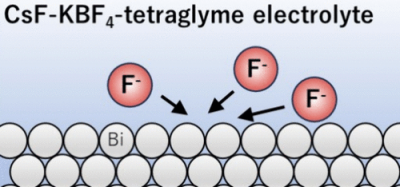
Fluoride shuttle batteries (FSBs) are promising energy-storage systems, because of their exceptionally high theoretical energy densities, based on multielectron metal fluoride redox chemistry. However, their practical development has been hindered by the low activity of fluoride ions in liquid electrolytes, originating from the poor solubility of fluoride salts and excessive fluoride complexation by anion acceptors. Here, we demonstrate that potassium tetrafluoroborate (KBF4), a simple and inexpensive inorganic salt, functions as an effective fluoride activity modulator in tetraglyme-based electrolytes. The introduction of KBF4 into a CsF–G4 electrolyte increases the dissolved Cs concentration, indicating promoted dissociation of CsF without strong fluoride immobilization. Cyclic voltammetry reveals a wide electrochemical stability window, while reversible fluorination and defluorination of bismuth electrodes are clearly demonstrated. Galvanostatic cycling of BiF3 composite electrodes showed well-defined charge plateaus at −0.75 V vs ref. This is more negative than the previously reported value with electrolytes using organic anion acceptors. X-ray photoelectron spectroscopy and scanning electron microscopy–energy-dispersive X-ray spectroscopy analyses confirm the reversible Bi0 ⇄ BiF3 conversion reaction during cycling. These results establish KBF4 as a chemically robust, low-cost inorganic additive that enables effective fluoride-ion transport by regulating fluoride activity rather than maximizing complexation. In this paper, we introduce an electrolyte design strategy for practical liquid-electrolyte FSBs based on minimal and scalable inorganic chemistry.
